In this article I provide an estimation on how much the standing height of the “American Giant” is affected by his abnormal spinal curvature (kyphoscoliosis). I argue that this is a question yet to be answered since previous estimations (Hinsdale, 1898; MacFarland, 1939) were based on methods associated with a high degree of uncertainty. By comparing the actual height of the spine with the theoretically normal height according to Delmas index, I show that the loss of standing height is 2,9 cm (1 1/8”). This value is significantly less than previous estimations has suggested.

Fig 1. “Mutter Museum Entrance” by Terry Robinson (2011), licensed under CC BY 2.0. Click on image to view larger version
The Mütter museum
The Mütter museum, part of the college of Physicians in Philadelphia, has been exhibiting medical anomalies, anatomical specimens and bizarre medical instruments since 1885. Among it’s huge collection of over 25,000 objects, visitors can be amazed by the plaster cast of “Siamese twins” Chang & Eng, pieces of Albert Einsteins brain preserved in glass slides, and a wall decorated with 40 diseased and injured eye-balls.

Fig 2. “Compare and Contrast: Giant, Dwarf and Average Skeletons” by George Widman (2009). Click on image to view larger version
One of the most spectacular objects that catch the visitor’s eye is doubtlessly the “American Giant”; the tallest skeleton put on display in North America (Fig.2). Not much is known about the American Giant except that he once was a native of Kentucky and probably died between the age of 22-24. The skeleton became part of the Mutter museum’s inventory under rather mysterious circumstances. In 1877 Professor Joseph Leidy was informed by Professor A.E. Foot that the body of a giant was for sale. However, the offer was conditional upon the requirement that no questions that could reveil the identity of the body were asked (Hinsdale, 1898, p.69). And to this day — 140 years later — the true identity of the American Giant has remained a secret. 1

Fig 3. Front cover of Acromegaly (Hinsdale, 1898). Click on image to view larger version.
As he stands, the American Giant measures 228,5 cm (7’6”), but since the spine is heavily curved, he would be even taller if the spine curvature was normal. The degree of the loss of height resulting from the curved spine is a question yet to be answered. Previous works (Hinsdale, 1898) and (MacFarland, 1939), have failed to give an reliable estimation due to questionable methods. I will argue that advances in the understanding of the human spine (Delmas, 1951), together with the documented measurements (Hinsdale, 1898) enables a definite answer to the following question: To what degree does the spinal curvature affect the standing height of the American Giant?
Previous estimations of the height

Fig. 4. Rear- and sideview of The American Giant. (Hinsdale, 1898, p.71). Click on image to view larger version.
In his essay Acromegaly (1898), Guy Hinsdale (1858-1948), M.D and former curator of the Mütter museum, compares the measurements of the American Giant with those of similar studies done on giant skeletons. Hinsdale concludes that the curvation of the spine “…detracts considerably from the height which would otherwise exist…” (p.71). He also admits that the standard method of estimating a body’s height — using the length of the femur — is of little use when dealing with bodies of abnormal proportions, since the estimation would be “slightly exaggerated” (p.71). He does, after all, apply this rule and arrives at two different heights whereas the two femurs differ in size. Using the right femur indicates a height of 235 cm (7’8 3/4”) while the left femur points to a height of 242 cm (7’11”).

Fig 5. Front cover of Transactions & studies of the College of Physicians of Philadelphia (1939). Click on image to view larger version.
Joseph McFarland (1869-1945), M.D and former curator of the Mütter musem, has written about the American Giant in “Notes on the Mütter American Giant” in Transactions & studies of the college of Physicicans of Philadelphia (1939). He takes on the mission to rank the height of the American Giant against other known giants in litterature. According to McFarland the American Giant ranks at place number 31. On the other hand, McFarland is — and rightly so — deeply sceptic regarding the correctness in some of the reported heights, and recognises that the American Giant would gain a higher ranking if one or two adjustments were made. First by eliminating those giants whose measurements were based upon unverified sources, and secondly by adding three inches (7,6 cm) to compensate for the curvature of his spine so that the attained height would be 7’9” (236 cm) (p. 158).
McFarland does not explain how he reached this conlusion and does not mention ever measuring the skeleton himself. He does, however, discuss the prediction made by Hinsdale and points out that the American Giant “…was probably something over seven feet, six inches, though probably less than the seven feet, eleven inches that results from the calculation based upon the length of the left femur…” (p. 152). It’s possible that his conclusion was just an intermediate value based upon the estimation made by Hinsdale. Or perhaps he just translated the number given by a legend printed on the skeletons case, saying that the American Giant lost 8 cm (roughly 3”) off his height because of the spinal curvature (p. 148).
The reason why the method, described by Hinsdale and McFarland, fails to give an accurate estimate of the corrected height is because the body of the American Giant is out of proportion. Consequently, any method that makes assumptions from the proportional relations between multiple body parts is unusable when applied to those that differ from the average. Still, in order to calculate the loss in height resulting from the spinal curvature, we do need some standard from which the height loss could be derived. Since we cannot deduce anything of certainty by observing proportional relations between multiple body parts; and since the cause to the height loss is found in the spine, I will argue that the height loss could be calculated solely by analyzing the spine.
The normal spine
André Delmas, french anatomist (1910-1999), described a method how to translate spinal curvatures numerically by dividing the actual height of the spine by it’s extended length (Delmas, 1951).
The length (L) is defined as the extended distance off the anterior surface between the atlas and the sacral plate, and the height (H) as the distance between the atlas and the sacral plate measured by a straight line (fig.6). The index (I) is given by the following formula:

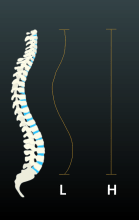
Fig 6. (L) is the extended length and the height (H) is the same distance measured by a straight line. Click on image to view larger.
Normally the index is close to 95 (± 1).2 An index above 96 signifies an almost linear spine, (as seen, for example, in cases of flatback syndrome) and an index below 94 reflects accentuation of the spinal curvatures, present in spinal variations such as lordosis, kyphoscolios and scoliosis (Louis, 1983, p.52). According to Hinsdale (1898) the spine of the American Giant measures “…from the atlas to the promontory of the sacrum, 820 millimeters; from the same points in a direct line, 750 millimeters…” (p.76). Applying the formula on the American Giant we thus arrive at the following index:

The Delmas Index of the American Giant turns out to be 91,46, which reflects the accentuated spinal curvatures. Again, in order to calculate the height loss from the spinal curvature, we need some form of standard to compare with. I will consider the theoretically normal height of the spine — with an index of 95 — as the standard. We can now define a formula that subtracts the actual height of the spine from the theoretically normal height. The deviation (D) from the standard height is thus either reflecting a loss of height (negative number) or a gain in height (positive number) in relation to the Delmas index.

According to this formula the loss of height caused by the accentuated curval spinature is 29 millimeters or 2,9 cm (1 1/8”). In other words, the actual height of the spine is 29 mm (1 1/8”) shorter than the theoretical normal height, according to the Delmas index. Compensating for this loss, the height of the American Giant, assuming normal spinal curvature, would thus be 231,4 cm (7’7 1/8”).
Conclusion
My aim with this post was to answer the question: to what degree does the spinal curvature affect the standing height of the American Giant? Contrary to previous estimations, that was associated with a high degree of uncertainty, I have provided a more precise answer to this question, arguing that the curvature decreases the standing height by 2,9 cm (1 1/8”). The corrected standing height of the American Giant would therefore be 231,4 cm (7’7 1/8”). MacFarland (1939) suggested a corrected height of 236 cm (7’9”) by adding three inches (7,6 cm). Knowing that the total difference between the height and length is actually only 7 cm (2.75”), it is easy to see that this estimation is impossible since it supposes a spine height wich exceeds it’s extended length.
Notes
1 There is a current debate on this topic. On the forum attached to the website The Tallest Man, there is a lengthy thread in which three possible candidates are suggested. The first two, Jim Porter and John M. Baker, lived in Kentucky and stood (according to newspapers) 233,5 cm (7’8”) tall. The third candidate; James Toller, might seem like a long shot since he was neither a Kentucky native or even American, but an Englishman. Neverthless, as Garth Shalam writes on his website Anomalies : “…given that the body was sold on a ‘no questions asked’ basis, theories that include body snatching and overseas theft start sounding entirely possible as explanations for why no questions were wanted..” (Shalam, 2017).
2 This average was based upon examinations of a total sample of 550 people; 350 of mixed age/gender and 200 young men (Petitdant, 2006).
Reference list
Delmas, A. (February 1951). Types rachidiens de statique corporelle. Revue de Morpho-Physiologie Humaine, pp. 26-32.
Hinsdale, G. (1898). Acromegaly : an essay to which was awarded the Boylston Prize of Harvard University for the year 1898. Detroit, Warren. Available from: https://archive.org/details/b21501117
Louis, R. (1983). Surgery of the spine: Surgical anatomy and operative approaches. Berlin, Springer-Verlag.
MacFarland, J. (1939). Notes On The Mütter Giant. In Transaction & studies of the College of physicians of Philadelphia. Philadelphia, College of Physicians of Philadelphia. (pp. 148-158). Available from: https://archive.org/details/transactionsstud4619coll
Petidant, B. (2006). Morphotypes : rendre à Delmas ce qui lui appartient ou relire et corriger Kapandji. Kinésithérapie la Revue, 6(60), 40-41. Doi:10.1016/S1779-0123(06)70291-1. Available from: https://www.researchgate.net/publication/250779802_Morphotypes_rendre_a_Delmas_ce_qui_lui_appartient_ou_relire_et_corriger_Kapandji
Shalam, G. (2016, October 27). 1877: Who is the Mütter Museum Giant? Retrieved April 11, 2017, from http://anomalyinfo.com/Stories/1877-who-mutter-museum-giant
 Height Detective
awesome